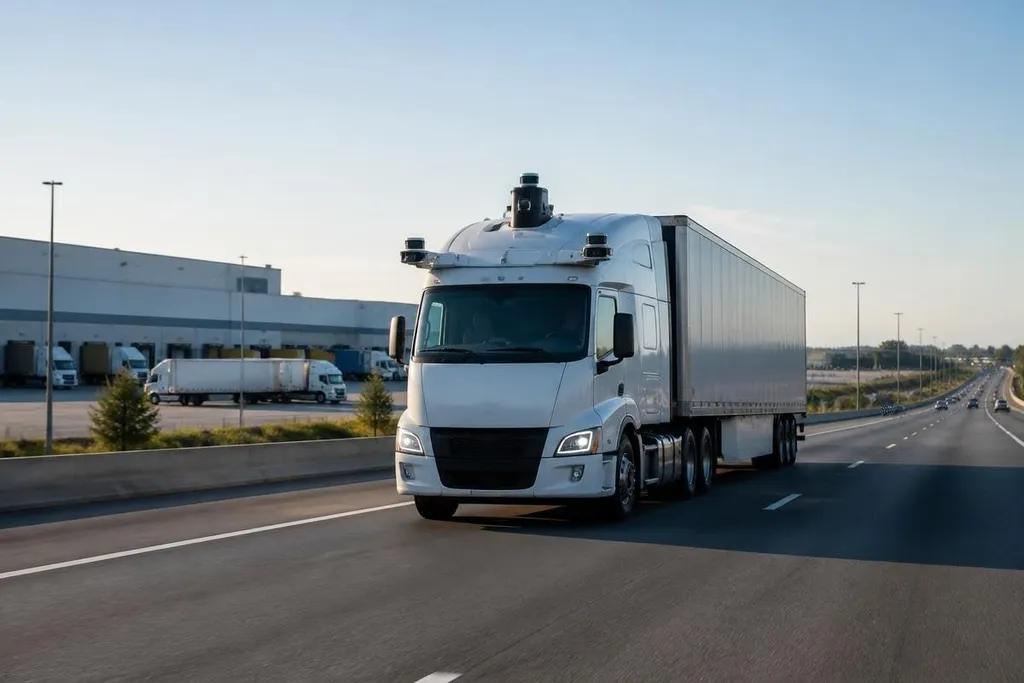
Self-driving trucks are most likely to change the middle part of a freight trip first: the repeat route between a depot and a hub. The reason is practical. A vehicle can work within a mapped area, with fewer road changes and fewer unusual stops.
- Repeat routes suit the software
- Hubs let people handle the first and last miles
- Weather, roadworks, and handoffs still limit the system
The route matters more than the truck
A self-driving truck uses several sensor types to build a view of the road. Cameras read lane lines and signs. Radar measures the position and speed of nearby objects. LiDAR sends out light pulses to map shapes and distance.
The software combines those inputs with digital maps and a route plan. It must decide when to slow down, change lanes, stop, or give control to a remote operator. That work gets easier when the route has been mapped, tested, and used many times.
This is why hub-to-hub freight makes sense as an early use. The vehicle can leave one logistics site, follow a known highway route, and reach another site where people or a different vehicle take over. The trip has a clear start, a clear finish, and fewer tasks at the roadside.
Hubs change the shape of the job
The truck does not remove every human task. It moves some of them to places built for loading, inspection, and handoff.
At a hub, workers can check the trailer, connect a new one, clear a blocked sensor, or move freight to a local vehicle. A remote operator may handle a rare road event, such as a police diversion or a temporary lane pattern. That operator might help with more than one truck, but the required staffing model depends on the system and its safety rules.
The handoff also creates a new planning problem. A local driver or delivery vehicle must arrive at the right time, with the right trailer and load information. If the automated truck reaches the hub early but the next vehicle is late, the freight still waits.
Logistics teams can track the companies, trucks, and software behind this shift through robotics reporting from Robot24.com. The useful question is what these systems do beyond a planned route, where weather, roadworks, and people can disrupt the handoff.
The hard parts are outside the planned route
Performance on a known road doesn't guarantee safe work around rare, unclear, or poorly mapped events. Road construction can move lanes overnight. Heavy rain can reduce camera and LiDAR performance. Snow can cover lane markings and change the road surface.
Urban drop-offs add more problems. The vehicle may need to read a temporary sign, wait for a person directing traffic, find a safe stopping place, or deal with a narrow loading area. Those tasks involve more than keeping the truck between lane lines.
Safety also depends on what happens when the system cannot make a safe choice. It may stop in the travel lane, pull over, ask for remote help, or hand control to a person in the cab. Each choice affects traffic, staffing, response time, and the design of the route.
The open question is not whether a truck can steer itself on a good day. It is how often the full freight operation needs human help, and how quickly that help arrives.
A practical check before deployment
A logistics team should answer these points before putting an automated truck on a live route:
- Map the route: Record lane changes, loading sites, toll points, construction zones, and places with weak network coverage.
- Set the handoff: Name the hub, the person in charge, the trailer process, and the time allowed for each transfer.
- Count remote events: Log every request for human help, including the reason, location, and time needed to clear it.
- Plan bad weather: State when the truck slows, stops, or leaves the route because sensors or road markings become hard to read.
- Check the local leg: Track how freight moves after the hub, since that part may still need a driver.
The list matters because a truck is only one part of the trip. A smooth automated run can still produce no gain if loading, handoff, or local drop-off stays slow.
I'd wait for route-level records showing human help requests, stopped trips, and completed freight transfers before treating a self-driving truck as a fleet purchase.
The next useful proof will come from full routes, not isolated miles: a truck leaving one hub, reaching the next, handing over its load, and repeating that work through changing weather.